
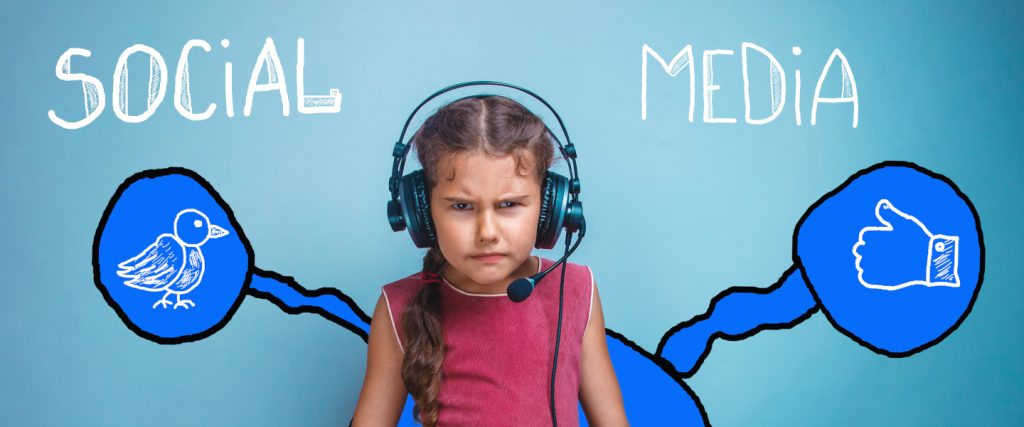
World Social Media Day is celebrated every June 30th. It came about to recognise a technology that promised to bring people closer together, democratise access to information and expand spaces for participation.
That promise did indeed exist. But today it is legitimate to ask ourselves if we continue to celebrate a reality or the memory of a good idea.
Social media has transformed the way we get information, how we relate to others and how we participate in public life. Nevertheless, much deeper things have also changed: the way in which public opinion is constructed, how citizenship is exercised, and how the personality of millions of people is developed.
And this deserves some critical reflection.
The problem is not social media. The problem is the business model on which much of it has been built.
Attention as a business: when algorithms rewrite the public sphere
When profit depends on the amount of time we can retain a user, attention ceases to be a right and becomes a resource that must be caught at whatever price. Algorithms do not necessarily reward what is true, useful or constructive. They reward whatever generates more interaction.
And few things generate as much interaction as indignation, fear, polarization or confrontation.
The result is an ecosystem where the most extreme content travels faster than the more rigorous ones, where misinformation finds fertile ground, and where each user ends up living inside a reality designed by an algorithm that knows their emotions better than they do themselves.
It is no coincidence that informational manipulation has become one of the greatest risks to our democracies.
Today we know that state and non-state actors use the platforms to influence electoral processes, amplify hate speech, sow distrust of institutions, and to erode public debate. Artificial intelligence adds a new dimension to this challenge by facilitating the mass creation of synthetic content that is virtually indistinguishable from reality.
A democracy doesn’t need censorship to become weaker. It is enough for citizens to stop sharing the same reality they are debating about.
Childhood, mental health and democracy: why platforms must be held accountable
But there is another cost that is just as worrying.
While adults see our ability to freely debate threatened, millions of children and adolescents grow up in digital environments designed to maximize the time spent in them but not necessarily the young people’s well-being.
Their attention is turned into a financial asset. Their emotions feed recommendation systems. Their behaviour generates data that has enormous commercial value. And their psychological development ends up exposed to dynamics that no previous generation has experienced.
It is paradoxical that we demand strict safety controls for a toy, drug or car, yet we allow platforms used daily by hundreds of millions of children to be put on the market without having to previously show they are safe for their development.
We continue to transfer responsibility to families, teachers, and the users themselves.
But no family can compete with artificial intelligence models trained to catch attention. No teacher alone can neutralise systems that continually learn how to increase the time spent on them. And no citizen has enough information to understand why exactly they receive the content that appears on their screen.
This is why the debate can no longer focus solely on digital literacy.
We need to talk about responsibility.
Responsibility of the platforms in regard to the design of their products.
Responsibility for how their algorithms work.
Responsibility for the impact they have on mental health, childhood, the quality of public debate, and the integrity of democratic processes.
The time has come to reverse the burden of proof.
If a company designs systems capable of simultaneously influencing the mental health of millions of minors and the public conversation of entire societies, it should be the company who demonstrates that these systems are safe, transparent, and compatible with basic rights before rolling them out on a large scale.
When protecting minors is protecting democracy
This is not about demonising technology.
Social media has created extraordinary opportunities for education, innovation, research, citizen participation and freedom of expression.
But precisely because they are now an essential infrastructure for our societies, we must demand from them the same level of responsibility that we demand from any other industry whose operations can affect public interests.
Perhaps this June 30th is not a day to celebrate social media.
Perhaps it should become the day when we remember that a democratic society cannot be built on algorithms whose only objective is to maximize attention time.
Because protecting our children and protecting our democracies are not two separate debates.
They are, most likely, the same challenge.